Short answer: You don’t learn self-defence in a weekend course, but through regular training against real resistance. The best self-protection is still to avoid conflict or walk away. If it does get physical, many situations end up in a clinch or on the ground – exactly where grappling like Brazilian Jiu-Jitsu is strong.
By Rodrigo Fernandes, Brazilian 3rd-degree black belt, training BJJ since 2001, who spent many years working security in Berlin’s nightlife – Head Coach at BJJ DOJO Berlin (Checkmat).
What self-defence really means
In films, people fight until someone is on the floor. In real life, the winner is the person who never has to fight. Good self-defence has three levels:
- Awareness: spot situations early, keep your distance, know where the exits are.
- De-escalation: calm voice, clear boundaries, don’t let yourself be provoked. Walking away isn’t losing.
- Physical defence: only when nothing else is left – and then it has to work under stress.
You can read about and practise levels 1 and 2. Level 3 you only learn on the mats.
Why training against resistance is the key
Many courses teach techniques against a partner who stands still. That feels good – but a real attacker doesn’t stand still. They’re heavier, faster and unpredictable. Under adrenaline you forget everything you’ve only practised a few times.
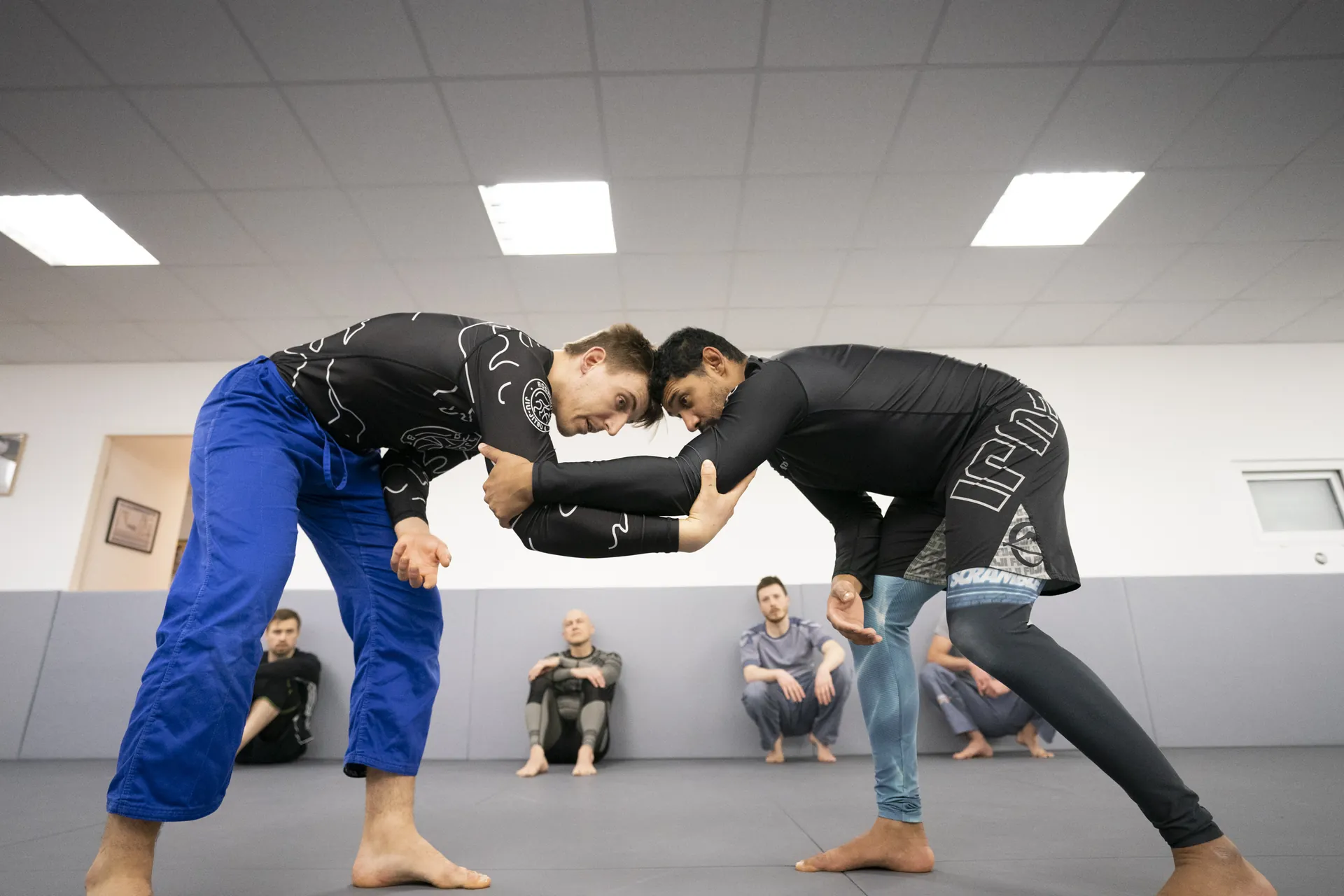
So the most important question for any school is: do you regularly train against full resistance? In BJJ this sparring is called “rolling”: both people go hard, but with control – if you’re caught in a lock or choke you tap, and the round restarts. That way you test every week what actually works, without getting hurt.
Why the ground matters so much
From my years working the door I can tell you: many fights quickly go to a clinch or to the ground – someone trips, grabs or pulls. If you don’t know how to protect yourself on the bottom, get back up or take control, you’re in serious danger.
That’s exactly what Brazilian Jiu-Jitsu trains:
- Surviving on the bottom: protect your head, create space with your legs and hips.
- Getting back up: the “technical stand-up” is one of the first movements you learn with us.
- Control instead of violence: holding someone down and calming the situation without having to hurt them.
- Bigger opponents: using leverage instead of strength.
Honesty matters here too: against multiple attackers or weapons, no martial art works reliably. Then there’s only one rule – get away.
Which martial art is good for self-defence?
| Strength | Limit | |
|---|---|---|
| Brazilian Jiu-Jitsu | ground, clinch, control without strikes, lots of sparring | little defence against strikes on the feet |
| Judo / wrestling | balance, throws, stopping takedowns | little groundwork after the throw (judo) or no submissions (wrestling) |
| Boxing / Muay Thai | defending strikes, distance, toughness | little plan on the ground |
| Krav Maga | scenarios, weapons, stress drills | quality and sparring vary a lot between schools |
| Short courses / weekend seminars | awareness, first basics | too little repetition for a real situation |
The ideal is grappling plus some stand-up work. If you can only choose one and don’t want punches to the head, BJJ is a very good place to start.
How long until I can defend myself?
After a few weeks you’ll know how to survive on the bottom and get back up. After a few months of regular training (two or three times a week) you’ll move much more calmly under pressure. The most important change happens in your head: you know the feeling of someone heavier pressing on you – and you don’t panic. How often makes sense is covered in How often should you train BJJ?
Learning self-defence in Berlin-Kreuzberg
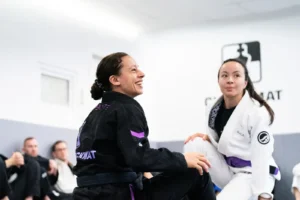
At BJJ DOJO Berlin women and men, beginners and advanced students train together, in the gi and in no-gi. There’s also a dedicated women’s class. The best start is our introductory course. If you live in Berlin, your first class is a free trial class. All times are in the training schedule.
FAQ
Can you learn self-defence in a short course?
A course can give you awareness and first techniques. For it to work under stress, you need regular training against resistance over months.
Is BJJ good for self-defence?
Yes, especially for everything that happens in a clinch or on the ground. It doesn’t replace common sense, though: avoiding and walking away remain the best defence.
Am I too small or too weak?
No. BJJ was developed precisely so that technique and leverage work against strength.
Do I need to be fit to start?
No. Fitness comes with training. You set the pace.