Short answer: Arrive 10–15 minutes early, bring water, flip-flops and comfortable sportswear without zips, cut your nails and leave jewellery at home. A class has a warm-up, technique and drills with a partner. The most important rule: tap early – and let go immediately when your partner taps.
By Rodrigo Fernandes, Brazilian 3rd-degree black belt, training BJJ since 2001 and guiding beginners through their first steps for more than 15 years – Head Coach at BJJ DOJO Berlin (Checkmat).
What to bring
- Clothes: if you have a gi (kimono), bring it. Otherwise long sports trousers and a tight T-shirt or rashguard are fine – no zips, buttons or pockets. For no-gi classes you wear a rashguard and shorts without pockets.
- Flip-flops: off the mat you wear shoes or flip-flops, on the mat you’re barefoot. That keeps the mat clean.
- Water and a towel.
- A good mood and no expectations. Nobody expects you to know anything yet.
Not sure what to wear, or need to borrow a gi? Just ask us beforehand.
How a class works
- Warm-up: movements you’ll need later – rolls, hip escapes (“shrimping”), standing up.
- Technique: the coach shows a position or technique. You drill it with a partner, first without resistance.
- Positional sparring: you practise one specific situation with increasing resistance.
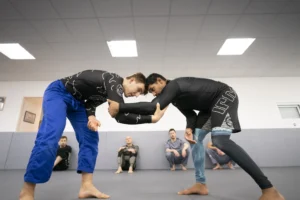
- Sparring (“rolling”): free training against resistance. As a beginner you ease into it. If you’d rather just watch in your first class, tell the coach – that’s completely fine.
The most important mat rules
- Tapping: when a lock or choke gets uncomfortable, tap your partner or the mat two or three times – or say “stop” out loud. Tapping early isn’t weakness, it’s intelligence.
- Let go immediately: when your partner taps, you release straight away. No discussion.
- Control over strength: work slowly and with control, especially with joint locks. No jerky movements.
- Mention injuries: if your knee, shoulder or back hurts, tell your partner and the coach before the drill.
- Listen to the coach: when the coach speaks or stops the round, you stop.
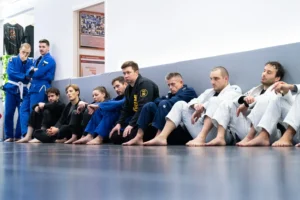
- Respect: everyone was a beginner once. We help each other, whatever the belt colour.
Hygiene: non-negotiable
BJJ is a contact sport, so these apply to everyone:
- Fingernails and toenails cut short.
- No jewellery, watches or piercings that could injure someone.
- Freshly washed training clothes, every single time.
- Skin rash, open wounds or a cold: stay home until it’s healed.
- Barefoot only on the mat – not in the toilet or hallway.
What to expect after your first class
Probably sore muscles in places you didn’t know you had muscles. And probably the feeling that you understood nothing. Both are normal. After a few weeks you’ll start recognising positions, and suddenly a lot makes sense. More in Is BJJ hard?
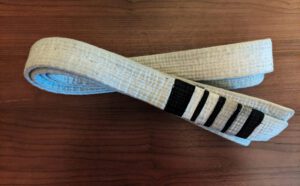
You’ll also learn to tie your belt properly – step by step in How to tie a BJJ belt.
Your first class at BJJ DOJO Berlin
You live in Berlin and are thinking about becoming a member? Then your first class is a free trial class. For a structured start there’s our introductory course, which takes you step by step into regular training.
Just visiting Berlin, or already training somewhere else? Then you’re welcome as a visitor, for example at our Open Mat.
All times are in the training schedule. Classes are taught in English whenever someone on the mat needs it.
FAQ
Do I have to spar in my first class?
No. Tell the coach if you don’t want to roll yet. You start at your own pace.
Do I need my own gi?
Not for your first class. If you train regularly, your own gi is worth it. Ask us before you buy one – we’ll tell you what to look for.
What if I’m not fit?
Then you’re starting at exactly the right point. Take breaks when you need them and drink enough.
How early should I arrive?
10–15 minutes before the start, so you can arrive calmly, get changed and meet the coach.