
Short answer: Adults in Brazilian Jiu-Jitsu have five belts, in this order: white → blue → purple → brown → black. After that come degrees on the black belt, the red-and-black and red-and-white coral belts, and finally the red belt. Kids have their own system with grey, yellow, orange and green belts. Getting to black belt usually takes 8 to 12 years.
By Rodrigo Fernandes, Brazilian 3rd-degree black belt, training BJJ since 2001 and teaching in Germany for more than 15 years – Head Coach at BJJ DOJO Berlin (Checkmat).
BJJ belt order for adults
| Belt | Minimum age (IBJJF) | Minimum time before next belt | Typical time in practice |
|---|---|---|---|
| White | – | none | 1–2 years |
| Blue | 16 | 2 years | 2–3 years |
| Purple | 16 | 1.5 years | 2–3 years |
| Brown | 18 | 1 year | 1–2 years |
| Black | 19 | degrees by years (see below) | a lifetime |
The minimum times come from the IBJJF graduation system. They’re a floor, not a schedule: someone training twice a week will take much longer than someone on the mat every day.
White belt: where everyone starts
Everyone starts at white – whether you’re 18 or 50, sporty or not. This is where you learn the basic positions (guard, mount, side control, back), the key escapes and how to move on the ground.
Honestly, it’s the hardest stage. You lose almost every round, use too much strength and gas out after five minutes. This is exactly where a lot of people quit. My advice after more than 20 years on the mat: stick with it. Every black belt is a white belt who didn’t give up.

Blue belt: the fundamentals are in place
A blue belt knows the fundamentals, defends well and has a few favourite techniques. The typical beginner mistakes are gone, and they understand why a position is good or bad.
Blue belt is also famous for the “blue belt blues”: you no longer feel like a beginner, but white belts still catch you. Many people stop here – even though blue belt is where the journey really begins.

Purple belt: connecting techniques
At purple belt, single techniques turn into chains. You react more fluidly, understand the “why” behind each movement and find your own rhythm in sparring. Purple belts are often uncomfortable training partners – even for black belts.
In many academies, purple belts already help with teaching and pass on what they know to beginners.

Brown belt: your own game
Brown belt stands for many years of training. Brown belts have built their own system that fits their body, age and strengths. Instead of collecting new techniques, they refine details, timing and pressure.
Brown belts are role models in the academy – the bridge between beginners and black belts, on and off the mat.

Black belt: a new beginning
Black belt doesn’t mean you’re “finished”. It shows that you understand the art in depth, can apply it under pressure and can teach it to others. A black belt should be solid everywhere: standing, on the ground, in self-defence and in teaching.
Character matters just as much: respect, integrity and the willingness to keep learning. For me personally, the real learning only started at black belt.
After black belt: degrees, coral belts and the red belt
| Level | Belt | Minimum time (IBJJF) |
|---|---|---|
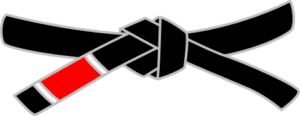
| 1st–3rd degree | Black with stripes | 3 years each |
| 4th–6th degree | Black with stripes | 5 years each |
| 7th degree | Red and black (coral belt) | 7 years |
| 8th degree | Red and white (coral belt) | 7 years |
| 9th degree | Red | 10 years |
| 10th degree | Red | reserved for the pioneers of BJJ (Gracie family) |
That makes the red belt the highest belt in BJJ. Very few people in the world wear it – usually after more than 40 years of training.
Stripes on the belt
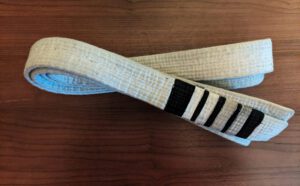
Between belts there are stripes, usually up to four per belt. They show progress within a colour and are mostly there for motivation. How and when stripes are given is up to each academy. Here’s how we do it at BJJ DOJO Berlin.
BJJ belts for kids (4–15)
Kids have their own system so they can progress step by step over the years. Under IBJJF rules there are these belts, each in a white, solid and black version:
- White – the start
- Grey (grey-white, grey, grey-black) – from age 4
- Yellow (yellow-white, yellow, yellow-black) – from age 7
- Orange (orange-white, orange, orange-black) – from age 10
- Green (green-white, green, green-black) – from age 13
At 16, teenagers move into the adult system – usually to blue belt, and with a green belt and lots of experience sometimes straight to purple.
In our kids BJJ classes in Berlin-Kreuzberg belts are never handed out for free. Kids earn them through training, effort and behaviour – each at their own pace.
How do you get your next belt?
Most BJJ academies don’t have a formal belt test. Instead, the coach watches you over months and years:
- Technique: how many techniques can you do cleanly – and do you understand them?
- Sparring: can you make them work against real resistance?
- Consistency: how often and for how long have you been training?
- Competition: not required, but it shows how you handle pressure.
- Attitude: respect for partners, coaches and the art.
How long the whole journey takes is covered in How long does it take to get a black belt in BJJ? – and if you just got your first belt: how to tie a BJJ belt.
Frequently asked questions
How long does it take to get a black belt in BJJ?
Usually 8 to 12 years of consistent training (3–4 times a week). Under the IBJJF minimum times about 5–6 years is theoretically possible, but very few people manage that.
What is the highest belt in BJJ?
The red belt (9th and 10th degree). The 10th degree is reserved for the pioneers of Brazilian Jiu-Jitsu.
Who wears a red belt in BJJ?
Grandmasters who have taught as black belts for several decades – for example members of the Gracie family and other pioneers of the sport.
What do the stripes on a BJJ belt mean?
They show progress within a belt colour. There are usually up to four stripes before the next belt. On a black belt, the stripes are the degrees.
Can you skip a belt in BJJ?
Not as an adult: everyone goes through white, blue, purple, brown and black. Only when moving from the kids’ system to the adult system can an experienced teenager start at blue or purple.
Is there a belt test in BJJ?
In most academies, no. The coach decides based on technique, sparring, consistency and attitude. Some schools do have formal tests, especially for kids.
Is the BJJ belt order the same as in judo or karate?
No. BJJ has fewer adult belts and no yellow, orange or green belts for adults – those colours only exist in the kids’ system. That’s one reason a BJJ black belt takes so long.
Start your journey – at white belt
Every path to black belt starts with the first class. At BJJ DOJO Berlin in Kreuzberg you can start without any experience in our beginners course – in small groups, at your own pace, in English or German. Book a free trial class →