Short answer: Brazilian Jiu-Jitsu (BJJ) is a martial art, combat sport and self-defence system that mostly happens on the ground. Instead of punches and kicks, you use joint locks, chokes and positional control to make an opponent give up – even if they’re bigger and stronger. BJJ grew out of Japanese judo in Brazil and is now trained all over the world.
By Rodrigo Fernandes, Brazilian 3rd-degree black belt, training BJJ since 2001 and teaching in Germany for more than 15 years – Head Coach at BJJ DOJO Berlin (Checkmat).
BJJ in one sentence
Think of chess – played with your whole body. Two people try to control each other on the ground and finish with a lock or choke. Whoever gives up taps, and the round starts again. Nobody gets hit, and nobody gets hurt as long as everyone respects the rules.
Where does Brazilian Jiu-Jitsu come from?
In the early 20th century, the Japanese judo master Mitsuyo Maeda moved to Brazil. One of his students was Carlos Gracie, who passed the knowledge on to his brothers – above all Hélio Gracie. Because Hélio was physically slight, the family adapted the techniques to work with leverage instead of strength. That became what we now call BJJ.
BJJ went global in 1993, when Royce Gracie won the first UFC tournaments against much heavier boxers, karateka and wrestlers. Since then, practically every MMA fighter trains jiu-jitsu.
What does a BJJ class look like?
A typical class at our academy lasts 60 to 90 minutes:
- Warm-up with movements you’ll need later (rolls, hip escapes, technical stand-ups).
- Technique: the coach shows a position or move, and you drill it in pairs without resistance.
- Positional sparring: you train the same situation with increasing resistance.
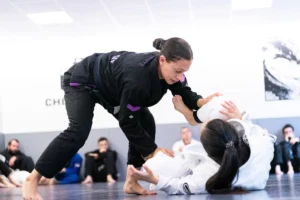
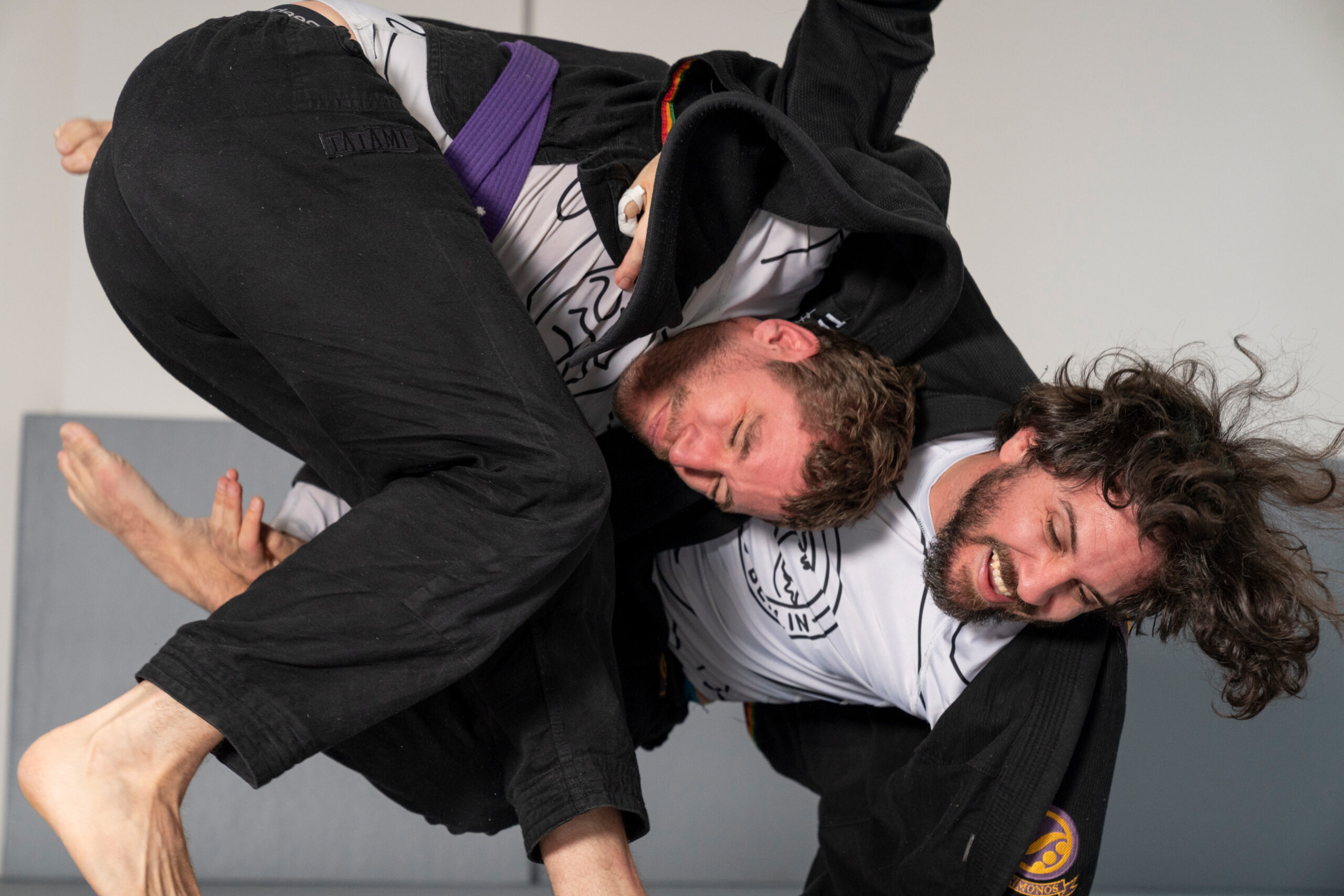
- Sparring (“rolling”): free training against full resistance – the heart of BJJ. Beginners ease into this gradually.
This sparring is exactly what makes BJJ so effective: you test every technique against someone who is really fighting back.
Key terms
- Guard: you’re on your back controlling the opponent with your legs. Sounds bad – it’s actually a strong position.
- Mount: you’re sitting on top of the opponent – one of the strongest positions.
- Side control: you’re lying across the opponent, pinning them from the side.
- Back control: you’re behind the opponent with arms and legs wrapped around them – the most dangerous spot for the person in front.
- Submission: a lock or choke that forces the other person to tap.
BJJ vs judo vs Japanese jiu-jitsu
| Brazilian Jiu-Jitsu | Japanese jiu-jitsu / Ju-Jutsu | Judo | |
|---|---|---|---|
| Focus | Groundwork, locks, chokes | Self-defence with strikes, kicks, throws | Throws from standing |
| Strikes/kicks | No | Yes | No |
| Sparring | Lots, against full resistance | Depends on the club | Lots (randori) |
| Competition | Gi and no-gi, submission or points | Various formats | Ippon by throw |
On clothing: BJJ is trained in a uniform (gi) or in a rash guard and shorts (no-gi) – we explain the difference in Gi vs no-gi BJJ.
Is BJJ good for self-defence?
Yes – with one honest caveat. Many real fights end up in a clinch or on the ground, and that’s exactly where BJJ lives. I worked in security for six years, and the adrenaline in a real confrontation feels very similar to a hard round of sparring or a competition. So self-defence comes from regular training against real resistance – not from a few tricks learned over a weekend. More on that in self-defence for women in Berlin.
What else does BJJ give you?
Fitness: an hour of BJJ trains strength, endurance, mobility and coordination – and you’re not thinking about exercise, you’re solving problems.
A calmer mind: on the mat you learn to breathe and think under pressure. That helps at work, at home, everywhere.
Community: after a few weeks you know your training partners better than some of your colleagues. BJJ brings together people of every job, age and background – in Berlin, that means a very international crowd.
Who is BJJ for?
Almost everyone. Kids from age 4, teenagers, adults of any age – plenty of people start at 30, 40 or 50. You don’t need experience or special fitness; that comes with training. Not sure? Read Am I too old for BJJ? and Is BJJ hard?
Frequently asked questions
What is BJJ good for?
Self-defence, fitness, confidence and a sport with a big, welcoming community. Kids learn respect, focus and how to handle pressure.
Does BJJ involve striking?
No. There are no punches or kicks in Brazilian Jiu-Jitsu. You control your opponent with grips, positions, joint locks and chokes.
Is BJJ hard to learn?
At first, yes – there’s a lot to learn and you’ll lose often. But that’s what makes it interesting. With regular training you’ll notice progress within a few weeks.
What’s the difference between jiu-jitsu and BJJ?
“Jiu-jitsu” originally refers to the old Japanese martial arts. BJJ is the version developed in Brazil, focused on groundwork and live sparring.
Can I learn BJJ with no experience?
Yes. Most people start with no experience and no special fitness. What matters is a good start with the fundamentals – for example in a beginners course.
What age can you start BJJ?
Kids from about 4, adults at any age. Many people start in their 30s, 40s or 50s.
Is BJJ dangerous?
Compared with striking sports the injury risk is low, because you tap in time and nobody gets hit. Typical issues are minor finger, knee or shoulder strains. With good coaches and controlled sparring the risk stays low.
Learn BJJ in Berlin
At BJJ DOJO Berlin in Kreuzberg you train Brazilian Jiu-Jitsu in small groups – for adults, kids and women, in English and German. No experience? Start with our beginners course. Book a free trial class →